Testimonium

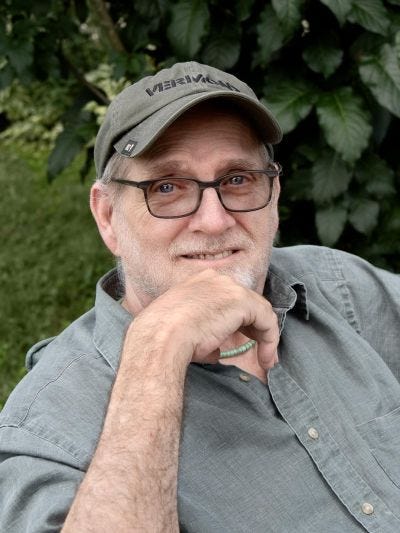
Photo at 70 by Gillian Randall
My life was cut in two is how I see it now, smashed and then severed. The chasm opened and I fell in, like Gandalf, to emerge another time in a different state.
That will be my only reference to Tolkien. For seven years I lived with a man whose life revolved around marijuana, pop music, and The Lord of the Rings. I mean no disrespect but hobbits are for teenagers and that’s all there is to it. I needed bigger fairy tales. I died. I came back. I am Lazarus.
It was my byline at the turn of the 2000s -- “Lazarus” -- when I wrote a regular column for POZ magazine about the unexpected pitfalls of returning from the dead. This was in 1997 and 1998, as the miracle of protease inhibitors began to reverse the tide of AIDS mortality in the United States. A death sentence was lifted and those of us still standing – many, not all – began to get well. To say we were amazed is no way to put it. We had to build our lives again, often from the start. I broadcast about it on NPR in 1996, when the new drugs first appeared:
One of the hardest things about an HIV diagnosis has always been the well-meant advice of other people – “people who are still walking on the sidewalk,” as Walt Odets has said, “while you are walking in three feet of sand.”
Maybe you’re familiar with the wisdom: “None of us knows how long we’re going to live. You could be hit by a bus at any time.” Like most cliches this is true as a statement of fact and false in every way that matters. People have a reasonable expectation of not being hit by a bus and among the unlucky few most don’t see it coming.
By contrast, living with HIV is like living on the exit ramps at Port Authority, where the buses roll over you all day long and you know -- you know -- that sooner or later one of them will crush you for good. After a while you get used to it: the organism can only take so much suspense. It’s the clarity of hopelessness I think I’m going to miss, the dispensation I was given to live as if there was no tomorrow. Because there wasn’t.
I was diagnosed with HIV in 1989 and put on AZT immediately – “rat poison,” we called it. It was the only medication at the time that helped, although it couldn’t promise much or suppress the virus for long. Other drugs of equal toxicity followed in clinical trials and left me with burning neuropathy in my legs and feet and a ravaged digestive system. I was quickly going crazy, writing book reviews and magazine stories and hopping from place to place. I fell in love with a man in Vermont but he died of AIDS in 1991, greatly embittered. He left me some money and I burned through it on “death trips” in different parts of the world.
In July 1993 I turned 40 and to mark the event I had every hair on my body removed by Tunisian épileurs in Paris; every one, apart from a tuft in the pubic region that was meant to rise from my Speedo – “pour la plage, Monsieur.” My only explanation for this episode is that I wanted to see someone else when I looked in the mirror. My viral load was high and my T-cells hovered just above the AIDS-defining 200 copies per microliter of blood. Two friends in the same condition committed suicide. I was in shock, stewed in chemicals, anxiety, and unprocessed grief. I gulped Imodium and began snorting cocaine. I no longer cared about being sober.
In 1994 I was nearly carried off by pneumonia in New York. I’m only alive because a friend came down from Vermont that day and got me to Lenox Hill Hospital, where they said I would have died within eight hours if I’d delayed any longer. I had the same pneumonia that killed Jim Henson of the Muppets, as it happens, Streptococcus group A, ultra-virulent and rapidly fatal. They put me on the AIDS floor and I had a tryst with my roommate, a “full-blown” case. “If that is life,” my therapist said, “and the opposite is death, you are in trouble.”
My cocaine days were brief but catastrophic; my family rescued me and by 1995, after leaving the city, I was broke and back in Vermont. A year later I started on Crixivan, a protease inhibitor, and began my second life. I did nothing to deserve it. I certainly didn’t earn it. I died. I came back. I am Lazarus.
The story of Lazarus is recorded in only one of the four gospels of the New Testament, and it’s John, of course, the loony one. Lazarus’ resurrection was the last miracle before the Crucifixion and so stunned the scribes and Pharisees that they resolved to have Jesus killed. They had to get rid of Lazarus again too, unfortunately, because anyone with a story so powerful was a menace to authority: “But the chief priests consulted that they might put Lazarus also to death; Because that by reason of him many of the Jews went away and believed on Jesus.” (John 12:11).
So, the first thing Lazarus had to deal with on coming back to life was a death sentence. I wish I’d had the leisure to ponder that message, but I was penniless and looking for a comeback. On Crixivan, I cleaned up my act. I sat on AIDS boards and committees, was a delegate to national conferences, talked about HIV prevention in schools and on the news, and became poster child for new healthcare initiatives in Vermont. I met a man in a support group, an architect who couldn’t work. We joined forces and lived together while I wrote, and wrote, and wrote. POZ magazine was then the leading organ of AIDS news and commentary in the United States and I picked up where I had left off in New York, in smart-aleck mode:
Not to be paranoid, but I think they liked me better up here before I started taking the pills. I was nearly dead when I crawled home to Vermont from New York last year. My health was gone. My career was in shambles. I was easy to deal with because I had only two moods, depression and hysterics, and only one thing to say when people asked me a question: “What difference does it make?”
Now it’s a different story. Crixivan and I are like Popeye and spinach. I’m Charles A. Lindbergh, P. T. Barnum, and Helen Keller all in one. I’m Scarlett O’Hara after intermission. You would be too if you had my creditors to deal with. And my relatives. And my editor. Lazarus had nothing but the Sanhedrin to worry about, while I’ve got an overdue book contract worth something in the six figures, as they say in the industry. Publishers want their money back if you don’t do the work. The only excuse is death and it has to be yours.
Unfortunately, the Bible doesn’t tell us what happened to Lazarus after the Crucifixion. There are church legends that sprang up later, naturally, ridiculous things having to do with Lazarus and Mary Magdalene, who took the last boat out of Jerusalem apparently and went to France, where Lazarus became Bishop of Marseille. At the same time he turned up in Cyprus, which is odd.
But I don’t believe any of these stories. I expect what really happened is that someone told Lazarus he was out of shape after four days in the tomb and that if he wanted to make the scene again he’d have to get back to the gym. This probably happened the minute he unwrapped his shroud and wiped the mildew from behind his ears.
What a card. I was never a hack until I started writing for shiny magazines. I had made it my goal to hit the top market in 1990, after American Cassandra, my second book, appeared to great acclaim and Little, Brown, my fumbling publishers, did nothing to promote it. I mean nothing. The advance had been high, but no effort was made to earn it back. “They don’t call them Big Brown,” someone said, but I felt badly served. I had just had my diagnosis. I lived for a while on money from Anastasia and the large sums editors were then paying for magazine pieces -- Condé Nast, in particular, although there were others. I was in Russia, Romania, London, Paris, Egypt, Berlin, Monaco, etc. But the only stories I’m proud of from that time are the ones that Tina Brown paid for and didn’t publish – she was famous for it -- and a sweet travel piece for Anna Wintour, who simpered on rejecting it that it was “not Vogue.”
I want it for my epitaph: He Was Not Vogue. I was a “walker” for Gloria Vanderbilt and in London for a varied number of dowagers and socialites. Through Anastasia I had connections in royal families; this wasn’t a downtown crowd. I dined with the Sacklers before they were odious and even helped one of them through a drug withdrawal in New York. In 1990, on the day her divorce from Goat Man became final, I was Ivana Trump’s “unidentified companion” at Le Cirque. Everyone else at the party that night, a media bash, turned their backs and refused to talk to her when she entered the room, camera lights exploding. She stood in a corner by herself. I felt sorry for her and pitched up in a few wire photos as her escort. I lived on the edges of everything. There were yachts and planes and helicopters and -- a notch down on the media ladder -- a hookup with Helen Gurley Brown, who asked me to write about royalty for Cosmopolitan.
“Royalty!” she said on the day we met. “That’s classy!” We were in the omelet line at one of Gloria’s brunches and she had cut in front of me. “But don’t give me any Greeks or Russians or Romanians. My girls want the Windsors and they want Monaco and that’s it.” I made a lot of money on Monaco eventually, selling and reselling poop about Princess Grace and her family. I became known as a “Grimaldi expert” with “inside sources” in Monte Carlo ( of which there aren’t any if you intend to keep them). After a lunch in New York with Gloria and Roddy McDowall, I was mistaken for Jack Nicholson on the street. Oddly, it happened a lot. Roddy took pictures and we stood arm in arm as a woman approached us from the corner:
“I know who you are. You’re Roddy McDowall.”
“Yes.”
“You’re my favorite actor.”
“Thank you.” Then to us: “I pay her to say that.”
“I wish you would pay me,” she answered. “I’m sure you have a lot more money than I do.”
When the celebrities departed she followed me to the bus. It was like talking to Lily Tomlin.
“So, is he here making a movie?”
“I don’t know. We just had lunch.”
“He’s my favorite actor. Are you a movie star?”
“No, I’m a writer.”
“You look like a movie star. You look like ... Jack Nicholson.”
“Stop it! You’re the third person this month who’s said that!”
“That other woman, that was the Vanderbilt girl.”
“Yes.”
“I can tell because she never wears make-up. She’s got a lot of money. I don’t feel sorry for her at all.”
“Well, you should,” I said as the bus pulled up. “Poor little rich girl.”
None of this was good for my soul. An editor I called Golden Boy saw my book reviews in The New York Observer and told me he would pay any price, make me rich, do whatever it took to get me in his pages. I had “the lightest touch in the business,” he said, imploring me to write for his men’s magazine, one of those golf, socks, gadgets, whiskey-and-Scottish-castle glossy wastes of pulp. He wanted to give it some “buzz.”
Golden Boy was physically beautiful, patrician to the bone, with tailored suits, smiling features, and generous hands. He asked me to write a column that satirized women and I did, offensively. I call it my Skull and Boner period. Here were money, power, God, history, sailboats, tennis, and big cigars. But I was fired after a year on the heels of my health collapse, when a lower editor, the worst I’ve ever encountered, concealed a deadline from me and I submitted some truly awful copy trying to catch up. I confess it was terrible stuff, barely sketched on the page.
“Obviously,” said Golden Boy, who must have seen I was a little pink, “you don’t have what it takes to write for” — but the name of the magazine is unimportant. I insist on that; they were equally bad for my character. I kept at it even after the fall, through the production of two more books for Little, Brown, whom I had sworn I’d never work with again. But they outbid everyone for my biography of Isadora Duncan and I caved. Isadora earned the best reviews of my career and disappeared without trace, banished to the “dance section” of every bookstore in America. I had written in bold letters: This is not a dance book. Robert Gottlieb had reviewed it on the cover of the New York Times Book Review as Not A Dance Book. But there it was in Barnes and Noble, invisible on the lowest shelf in a corner near the floor, under books about Led Zeppelin and much-thumbed dictionaries of opera.
Problems like this are inevitable in a writer’s life. “You have had a good career,” said my editor at Little, Brown. I wrote for Salon in its heyday and produced a snarky newspaper column for a decade in Vermont, “Crank Call,” in which I unburdened myself cleverly of any notion or opinion that entered my head. ‘What a gift you have,” a reader wrote, “the ability to suppress your anger just enough to allow wit and good prose to flow.” It ruined me for writing. I started drinking again after 9/11 and my relationship fell apart. Three book projects came and went with nothing to show but lifeless proposals. I searched endlessly. Nothing would ignite.
In 2006 I got drunk on a flight to London and landed in Her Majesty’s prison at Wormwood Scrubs, charged with endangering an aircraft. They clapped me in irons at Heathrow and I spent six weeks “inside” with convicted terrorists and regular London goons, until the charges were dropped and I went home, still talking in the language and accents of the hole. I spoke for weeks as if I’d come from the East End. The therapists said I was traumatized but this was old news and I knew it. I published my diary of the experience as a feature in Salon and saw myself revealed as an ordinary drunk, grandiose and self-deceived, whom resurrection had done nothing to improve. Jesus wept. Only then, stunned and empty, did I know Lazarus in his plight.
Mine isn’t a story of addiction and recovery per se. I did recover; I live in recovery now, but the blessings I received at my lowest ebb were not of my design. They were given to me freely by others who’d been injured on the road. They’re available to anyone who’s willing to let go of the person they thought they were -- anyone with that privilege, I should say in all humility. The crisis we endured in the early days of AIDS has passed into history and my adventures into smoke. I never expected to enter my 70s, more or less healthy, more or less sane, looking back on a life cut deep at the root and left to heal and grow further as it could. If it could. To write about that time from a comfortable chair, to write about living while so many died, seems like disrespect, a gross impertinence. But that too is a story. I have lived, as I say, on the edges of everything, like a party guest no one can place.
The pieces that follow were written over a period of years, beginning in the Covid lockdown of 2020, at which time I was also recovering from surgery for lung cancer. I had stopped writing; I was finished with it, seeing also changes in publishing and mass communication that left me feeling grouchy and frankly grateful that my career had peaked in the 20th century.
“Still,” I recalled, “everyone writes a memoir. Everyone and anyone.” So I got to it, working in bursts. I had never written about myself as a subject and didn’t know if there was one to be found. Was I a character or a witness? Was there enough of what Germans call Stoff to warrant my writing it down? Publishers tell me that a memoir has to be focused on a single thing -- an adventure, an era, a problem overcome. “What’s the pitch?” they all say, which is code for, “How the hell are we going to sell this?”
I can’t answer; I can’t write to a marketing genre. The only constants I see in my story are a battle with addiction – about which everyone writes – and my unexpected survival with HIV, for which I take no credit. Am I afraid to revisit all that, to feel it again, the sorrow of loss, the terror of illness and decline? Was I ever a whole person before that awful thing cut me down? These questions stay with me as I write.
And I’m not wiser for the experience. I’m like most people, learning as I go, through repeated beatings and defeats. I am ordinary, in other words, a pill it took some time to swallow. We invent our own stories and mine is one of chastisement.
A good man, Peter Hendrickson, who was my therapist in New York, asked me in 1993 if I expected to reach the age of 50 and I said no, I didn’t. “Neither do I,” said Peter, who died of AIDS at 46. I was drawn to him first because he had written a book about our condition and it gave me heart when I was diagnosed. It touched me somewhere in the darkness of that time. Peter and his partner, Tim, were both dying when I was his client, and I remember how intentionally he approached his end, shedding parts of himself as he got sicker, shearing his hair in sacrifice, and sinking deep in meditation and self-reflection. He never said a word to me that wasn’t loving and supportive. He tried to help me but I ran, lost, too scattered and afraid to confront it. People close to me suggested that I “get in touch with my mortality” and I fled even further in dissociation, grabbing and lurching through a wall of fear that I remember but don’t recall, like childbirth pains. That I emerged intact, surviving to talk about any of it, is a wonder without revelation. All is vanity and a chasing after wind, says the prophet. Also, love abounds. If it didn’t, I wouldn’t be here.
It’s a known feature of HIV infection that chronic immune activation and inflammation can accelerate aging and trigger co-morbidities in long-term survivors. We grow older faster, basically, by three to five years, according to statistical reckoning. The price of survival in my case has been a heart attack, two cancers, multiple sinus surgeries, back pain, and what I’ve called a wonky cock, Peyronie’s disease, in which the curve of the penis is distorted by fibrous scar tissue in the tunica albuginea and corpora cavernosa, the spongy parts that fill with blood when aroused and keep the unit erect. With Peyronie’s, the shaft bends, sometimes grotesquely, as the medical handouts warn, “making penetration difficult and often painful.” I’d add “hilarious” because my disposition is mostly cheerful. I can’t afford to be grave in the circumstances.
The last piece I wrote for Salon was in 2007, as I headed for the light of a new sobriety. “Middle Age Threw Me a Wicked Curve,” the headline read:
I’m doing fine these days -- no detectable viral load, “perfect CD4’s,” “stunning results.” The last report was so good that my doctor wrote to say, “You’re going to live for a long time yet and have lots of opportunities for misery.” I am, it seems, no different from other people. And this is hard to accept when you’ve banked your life on being a special case. When I get around to writing my memoir, I’ll put a sad face on the jacket and call it So, You’re Not Going to Be a Tragic Character After All.
Peyronie’s is also called “partial penile disassembly.” It isn’t rare, exactly, but not common either, whatever that means. There are only a few treatments for it and none of them work. The most effective is surgery. “But I warn you,” my urologist said, “you’ll lose a couple of inches.” As general advice he urged me to ejaculate as much as possible going forward.
I didn’t know how to tell him.
“Doctor,” I said, “what is it about HIV you don’t understand?”
He was very calm. “Peter, if you want your willy to look like something other than a compass or a pretzel you’ll do as I say.”
As I left the office the receptionist chimed in.
“He told you to jerk off a lot, didn’t he?” she said.
“How did you know?”
“Oh, he tells that to everyone over fifty. You’re over 50, right?”
And I had to think and to remember: Oh, God, I am.
Finally, Peter. We’re reading abt YOU! I can hardly wait for your memoir. To say you’re a survivor is SOOO much of an understatement! God bless you, and bring it on!
Peter, I laughed and cried reading this. You inspire and enlighten with your words and I am so grateful for your presence in my life.