American Royalty

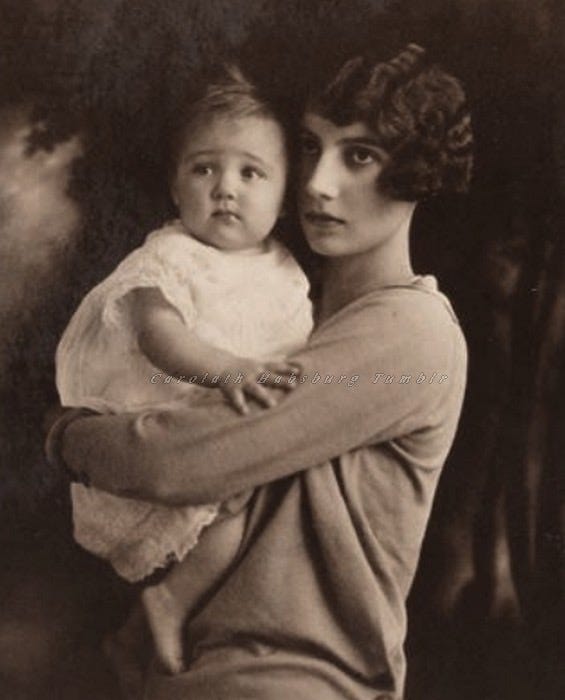
Princess Xenia of Russia with her daughter, Nancy Leeds, 1925
In May 1993 I drove through England with Nancy Leeds Wynkoop, my great friend from “Anastasia” days, daughter of Princess Xenia of Russia and a bona fide Romanov on her mother’s side. We started in Oxford and headed west to the Cotswolds, north through the Midlands to the Lake District, southeast through Yorkshire, and north again to Scotland, where we wound up in Pitlochry at the home of Major Sir David and Lady Myra Butter. Major Butter, whose military record included action in Italy and at El Alamein, had been Lord Lieutenant of Perthshire and Chieftain of the Pitlochry Highland Games. Myra, his wife, was the daughter of Sir Harold and Lady Anastasia (“Zia”) Wehrner, close friends of the Queen and the Duke of Edinburgh. She was Nancy’s second cousin through Romanov descent. Both were granddaughters of Russian grand dukes, brothers, Michael and George Mikhailovitch, one of them shot by the Bolsheviks in 1919 and the other – Michael, Myra’s grandfather – banished from Russia already before the Revolution after his marriage to an “unsuitable” bride, Countess Sophie von Merenberg, later de Torby, the child of a prince of Nassau and his unsuitable bride, Alexandra Pushkin, daughter of the poet.
Whew. I never had trouble keeping genealogical connections straight. I don’t know why – many people find it difficult. I had read all nine volumes of Queen Victoria’s published journals and letters by the age of 14 and learned too about the fortunes of her nine children, all but one of whom “had issue,” as the phrasing is, giving her 42 grandchildren and 87 great-grandchildren, most of whose names I still know, along with their wives’ and husbands’ and many of their descendants’. I’ve said before that a royal family tree is no more complicated than any other and it isn’t. But I had no answer when a therapist asked me why it mattered to know how a princess of Hesse might be related to the Duke of Fife.
“It doesn’t matter, I suppose.” said I. “Maybe it keeps the mind sharp, like crossword puzzles.” Driving with Nancy I heard family stories of a more intimate kind than I was used to, about her mother’s depressions and her father’s alcoholism, her husband’s drinking too, which had almost ended their marriage before he finally quit. Nancy’s mother, Princess Xenia, had died young, at just 62, following a series of strokes brought on in part, Nancy thought, by the strain of testifying for “Anna Anderson” in her suit to be recognized as Nicholas II’s daughter. There was no bitterness in Nancy’s voice when she remarked on this, for Xenia had “believed in her, and continued to believe in her,” despite all the pressure put upon her to recant. In Mrs. Anderson’s papers, left behind in Germany when she moved to the United States, I found a letter from Xenia addressed to “Dearest Anastasia,” dated 1958 and putting paid to assertions, mainly from Romanov cousins who never met the claimant, that Xenia had “changed her mind” on the identity question. She had not, dragging herself from a sickbed to testify formally and dying shortly thereafter. She might have been in error but her integrity isn’t in doubt.
Nancy was sad on our trip around England, solemn and wistful, saying that it would be her last visit to the British Isles and directing us toward places she was adamant to see while she could: Beatrix Potter’s cottage at Ambleside; the parsonage in Haworth, where the Brontës wrote their novels; Warwick Castle, and so on. She swept through these houses as if inspecting them for dust, with a briskness I had noted before when we went out in public. She was commanding but not arrogant; her ways were inherited. I remember a moment, early on, when she expressed herself horrified that her American daughter hadn’t curtsied to “Sitta,” Queen Helen of Romania, the mother of King Michael, when they met in Geneva. Queen Helen was Nancy’s godmother.
“I don’t know,” Nancy sighed. “I don’t know.” She demanded that we drive to Birdsall House in Yorkshire to meet the chatelaine, Janet Willoughby, Lady Middleton. She wanted to see the Middleton estate, an Elizabethan pile greatly extended and improved over four or five centuries. We had tea in the front room, Lady Middleton somewhat confused by the purpose of the visit but nodding eagerly when Nancy repeated that she was the daughter of a Russian princess who had lived in the area during World War I. In fact Princess Xenia had sat out the war as a teenager in Harrogate, while her own mother, Grand Duchess Maria Georgievna, used the hostilities as a means to separate from her Russian husband, Grand Duke George, without causing a stir. Their marriage had never been happy: George was besotted but Maria was not. She claimed to be trapped in Britain when the war broke out, unable to return home, although it would have been simple enough to find a way back through diplomatic channels had she really wanted to go. Xenia and her sister, Nina, never saw their father again. He was shot in St. Petersburg in the Fortress of Peter and Paul, leaving a deep resentment in his daughters against their mother.
“Mama hated England,” Nancy remarked several times as we whizzed around the isle. I was driving a stick shift and she had an annoying habit of tapping my hand whenever she thought I should change gears; over ten days I almost got used to it. She talked a lot about this grandmother, Maria, a Greek princess by birth, who seems to have been everyone’s favorite cousin and niece in the vast Greek and Danish line. In relaxed family photographs Maria is seen romping and laughing with the Tsar’s sisters, Xenia and Olga; with his mother, the Dowager Empress, and father, Alexander III; with her Aunt Alexandra, Queen of England, and Alexandra’s daughter Victoria and son, King George V. There are even pictures of Maria coaxing laughter from the last Tsarina, a near impossibility for anyone. In the family Maria was “Greek Minny,” so called to distinguish her from the Dowager Empress, also Maria, also “Minny” to anyone given rights of intimacy. Royal nicknames were definitive: Princess Xenia was “Tommy” to her relatives.
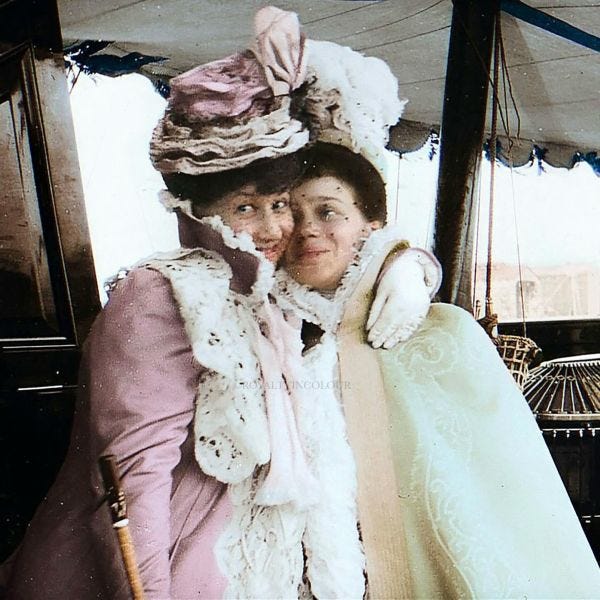
Grand Duchess Maria Georgievna (left) with her cousin Xenia Alexandrovna, sister of the Tsar. (Credit: @royaltyincolour)
After World War I and her husband’s execution in Russia, while returning home to Greece, Grand Duchess Maria fell in love with the commander of the ship that carried her, Admiral Perikles Ioannidis, quickly nicknamed “Percules” by astonished royalty. In 1922 she married him, much against the wishes of her family. It deepened the rift between herself and her daughters, both of whom had now found husbands of their own. Nancy met her grandmother only once, when Maria came to the United States from her final exile in Rome.
How good she was to me – Nancy, who had never needed to bother with an inquisitive boy amazed by her background. I had turned up on her doorstep in Vermont at age 17, wearing a tie and blazer and carrying a briefcase as a sign of my resolve. There were treasures in the house, not just linens, china, and silver, but Fabergé things and portraits of Romanovs going back generations. A photograph of Empress Alexandra, softly framed, was signed to Nancy’s mother, and the first time I stayed the night I slept under pictures of the Tsar. The décor, while not ostentatious, was nonetheless deliberate; I would learn that Nancy’s neighbors in Woodstock, a town not unused to social pretension, were never sure what to make of her, debating her authenticity while envying her heirlooms. Ed Wynkoop, Nancy’s husband, was “in finance,” and the family had moved to Vermont from Connecticut just a few years before I appeared. She told me later that over the years she had had many letters from people absorbed in the “Anastasia” case and had ignored them completely. Why she treated me differently she couldn’t say, except that I had seen her Aunt Nina on Cape Cod and “must have learned a little bit already.” Brien Horan and I – at the same age, coming forward at the same time – would be her “horses in the race,” as she put it, at a time when Anna Anderson was still living and the matter of her identity still sometimes seemed urgent.
In Nancy’s front rooms hung large canvases by Philip de László, the Hungarian royal portraitist and society painter. Two were of her mother, Princess Xenia, and the other of her second grandmother, Princess Anastasia of Greece and Denmark, formerly Mrs. William B. Leeds and before that Miss Stewart and Mrs. Worthington, the only American woman in history to have been made a royal highness “in her own right” – that is, independently of marriage, her prerogatives belonging solely to her, as if she had been born the daughter of a king. This was the bargain she had struck with the exiled King of Greece, Constantine I, when, in 1920, she married his younger brother, Prince Christopher, and used her great fortune to buy back the throne.
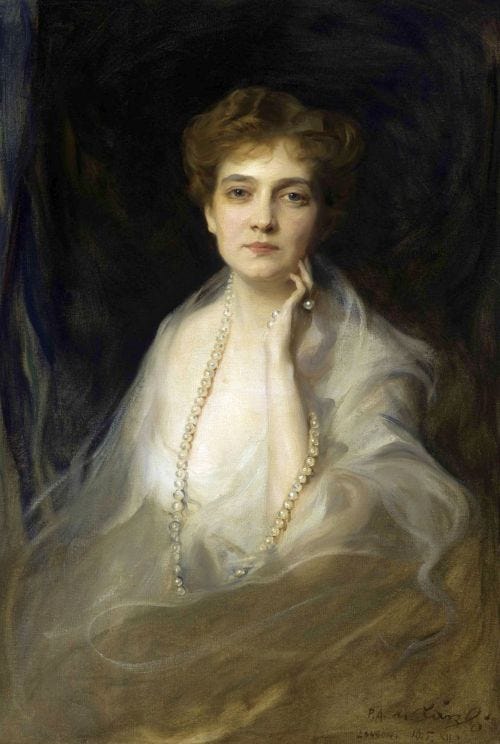
Princess Anastasia of Greece and Denmark by Philip de László, ca. 1920
Here it gets a little complicated. In 1917 King Constantine had been forced to leave Greece owing to his opposition to Greek involvement in World War I. A first cousin of both the Tsar of Russia and the King of England, masters of the Triple Entente, he was simultaneously married to the Kaiser’s sister and was suspected, probably correctly, of “German sympathies.” A schism arose in the Greek government and more broadly throughout the country, with Allied pressure bearing down to propel Greece into the conflict. Constantine remained firm in his stand for neutrality but was mooted finally by an Allied occupation of Macedonia. Under the virtual dictatorship of Prime Minister Eleuthérios Venizélos, he agreed to step down, without, however, surrendering his sovereign rights. His son Alexander, fully unprepared, assumed the throne as a kind of placeholder while Constantine and the rest of the Greek royal family removed themselves to Switzerland to wait out events. This is where Mrs. Leeds stepped in.
Nonnie May Stewart Worthington Leeds, the original “Nancy,” had been born in Ohio as the daughter of a wealthy businessman – a miner, banker, and real estate tycoon, from whom she seems to have learned important lessons in negotiation and money management. Homeschooled, she was sent for “finishing” to Miss Porter’s in Connecticut and in 1894, at age 16, contracted her first marriage, to George Ely Worthington, a Cleveland industrialist and luminary much like her father. There is confusion about how long this marriage lasted, or if it was even legal, an Ohio law mandating that women be at least 18 before entering matrimony. Whatever the case, as the press reported, “it was not long before the Worthington marital bark struck rough waters,” and the union was either dissolved by divorce or annulled on a technicality – probably the latter, for no hint of scandal or misbehavior followed Nonnie as she moved into high society. By 1900 she was free to marry the “Tin Plate King,” William Bateman Leeds, a former florist and railroad engineer who had subsequently earned an enormous fortune in the tinning industry. As a wedding present, he gave his bride a yacht, a million dollars in jewelry, and a mansion on Fifth Avenue, from where Nonnie, now known more formally as Nancy, began her rise to social prominence. In 1902 she had a son, William B. Leeds, Jr., instantly named “the world’s richest boy” by a slobbering press.
In the first decade of the 20th century, as its era waned, William B. and Nancy Leeds were the archetypal couple of the Gilded Age, sublimely wealthy and determined to enter the upper tier of New York society. This was mostly down to Nancy, whose gifts included charm and beauty as well as bottomless pots of cash. In 1903 newspapers reported that she had conquered “the Long Island set” – the Leeds’s had built a second home in Oyster Bay – and Palm Beach, where money alone was normally sufficient to open doors: “Her husband is said to be worth $30,000,000 [there is no way to calculate the actual value of this sum today] and this was her passport." It took longer to sway the old guard at Newport, where Leeds purchased “Rough Point” on Bellevue Avenue, later the home of tobacco heiress Doris Duke, and where Nancy sat out two seasons as a parvenue, waiting, until Mrs. O.H.P. Belmont, one of the three deciding dames of Newport society, threw a ball in her honor and marked her with the legitimacy she craved.
“Two years ago she did not exist,” a columnist noted. “Now she is seen motoring with Mrs. William K. Vanderbilt, Jr. and coaching with the Whitneys." She entertained royally, traveled constantly, organized charities and committees, and made the news just by leaving the house. A famous court case revolved around her jewelry. In 1906 Leeds had bought her a pearl necklace in Paris and paid American import duties only on the pearls, not the assembled piece, which would have been taxed at a higher rate. The United States government sued for the full amount and the case wound on for six years, being settled finally in 1912 in favor of a now widowed Nancy Leeds. William B., Sr. had died of a stroke in 1908, drunk, after trashing his room at the Ritz Hotel in Paris and tossing furniture out the window into Place Vendôme. The cost was simply added to the bill.
After Leeds’s death, Nancy sold her New York townhouse and moved to England, sending her son to another Leeds property in Montclair, New Jersey, where he was looked after by “a governess, a housekeeper, and 15 servants to meet his slightest wish,” according to a 1912 report. Two detectives accompanied him wherever he went. He had no playmates: “Mrs. Leeds keeps in touch with the lad almost daily through cable messages and is kept constantly posted as to his physical condition and progress in school.” Waited on hand and foot, his every whim indulged, he grew up to be a shining playboy, a sportsman, and a severe alcoholic. His mother brought him to London as he reached his teens and enrolled him at Eton, saying it would be good for his character. “Of course,” she remarked, “the young men in the social life of England [i.e., the wealthy] do not work, but they go in for sports and are healthy, strong and normal – and they do not drink as much as the idle young men of America.” She deluded herself. From her new domain in St. James’s Square, entertaining bankers and royalty, she may only have seen a small part of London.
In 1914 Nancy Leeds met Prince Christopher of Greece through the Countess de Torby, Myra Butter’s mother, and quickly determined to marry him. “Many a dented title has sought her hand,” the press reported, but royalty was her aim and she achieved it. Her engagement to Christopher was announced against opposition from the whole Greek royal family and especially its queen, Sophia, a granddaughter of Queen Victoria and sister of the Kaiser. When war broke out in August 1914 the matter landed on a back burner, although newsmen still occasionally asked questions and wondered about the status of this unusual romance. Prince Christopher, a “bachelor” of long standing, turned up amusingly in the newspapers as “a fair, rather fat and very pleasant young man … with the finest tenor voice among European royalties.” Nancy seemed content to remain in a state of engagement until the end of the war, when the revolutions in Russia, Germany, and suddenly Greece threw most of her royal friends into penury.
A monkey decided the matter. In 1920 the surrogate Greek king, Alexander, died of sepsis after trying to rescue a roaming macaque from his dogs while walking on the grounds of his palace at Tatoi. In the scuffle the monkey bit him on the leg and within three weeks he was dead. Alexander had been the more or less willing puppet of the prime minister, Venizélos, now embroiled in a war with the Turks, and his death stirred Greek monarchists to new heights of sentiment. When Venizélos was defeated in parliamentary elections at the end of 1920 a plebiscite called King Constantine back from Switzerland. Both votes had been heavily influenced by Nancy Leeds’s millions, which paid for anti-Venizélos and monarchist propaganda up and down the Greek mainland and were presumed to have “bought off” oppositional challenges. That her marriage to Prince Christopher went ahead at just this time – “the $40 million which the American widow possessed contrasting rather shockingly with the flat purse of the ruling Greek family” – and that she was given all the rights and prerogatives of royalty in the bargain virtually screamed of a backstairs deal.
But that was the last of Nancy’s victories. Not long after her royal marriage she was diagnosed with cancer and died in 1923 at the age of 50, having lived to see the marriage of her son, William Leeds, Jr., to her husband’s niece, Princess Xenia. The story is that Nancy Sr. wept for three days on hearing of this engagement, thinking that both her son and Xenia were too young for it, at 19 and 17 respectively. It can be inferred that both were trying to get away from their mothers. The marriage would last for nine years, heavily chronicled in society columns and severed finally by Leeds’s compulsive drinking, gambling, and “adventuring” in all parts of the world. In the meantime, neither his mother nor Xenia’s, neither Nancy Sr. or Grand Duchess Maria, before their deaths, renounced their rights of inheritance to the crown of Greece. This left Leeds’s and Xenia’s only child, my friend Nancy Wynkoop, directly in line to the throne after the children of the last king, Constantine II, who kept a sly eye on her movements until her death in 2006. “And how is my cousin … Nancy?” he would ask, as if trying to remember who she was. But he knew very well, and so did she.
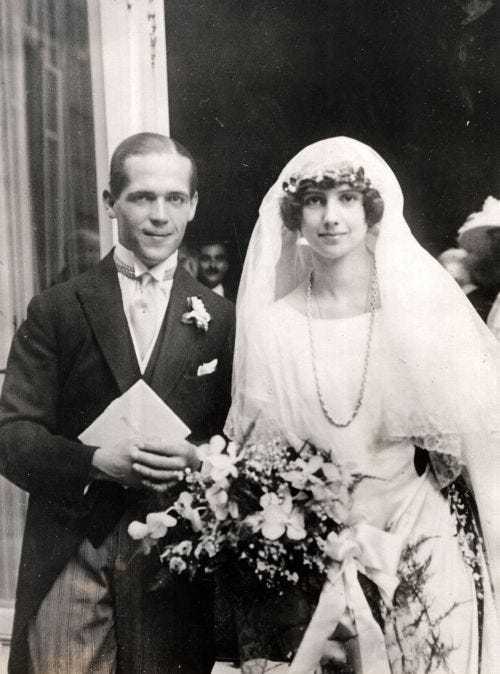
Princess Xenia and William B. Leeds, Jr. on their wedding day in Paris, 1921
My Lord, Peter! I was abt to draw a couple of family trees! How in the world do you keep all of these names straight! Bravo my friend. I imagine the Anastasia work is the pride of all of your writing. I love that book! And I agree with YOU!
Enjoyable and educational, as always. 💙