1994 - I

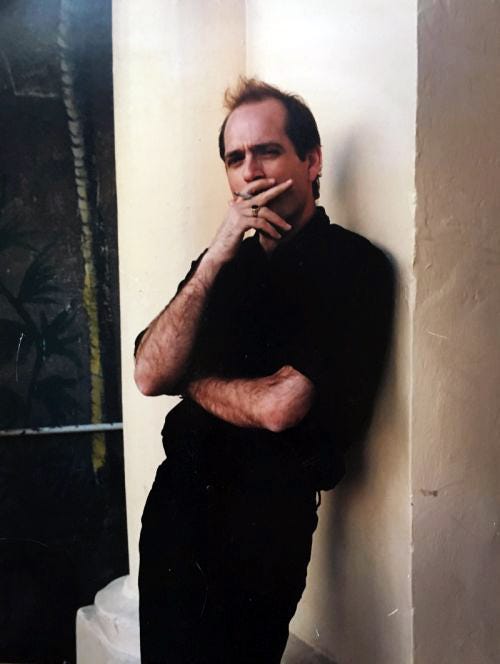
Key West, 1994. Photo by Gillian Randall.
When I went to therapy after my mother died I was asked to draw a picture of my life. The counselor had pencils, pens, crayons, and watercolors, and invited me to use any combination of these to depict my world on a sheet of paper. I have no artistic talent and react with alarm to pop-up assignments like this. I tried to be cool about it, although giving me the opportunity to release my true feelings must have been the point of the exercise.
“I’m really no good at this,” I said before I started, hedging my bets. Eventually there emerged multicolored shapes and figures that showed me sitting solo in the corner of a long room, looking across toward a doorway lit by sunshine. The therapist asked why I sat so far away from the light and I answered, “I do go out sometimes.” And then, more honestly, “But I prefer the indoors. I need a wall at my back or I lose my bearings.”
Later I reflected on the loneliness this picture displayed. The therapist said soothingly that I was “a witness, an observer,” and on good days I’m happy to think of it that way. I am not gloomy by nature. But there I sit, alone, despite the many people who’ve been with me in and out. It’s how I want it, plainly, and statistics will confirm that I’m not the only one: more than a quarter of the U.S. population now lives in a single condition, as they used to say. Half the population reports being lonely anyway, single or not, and I don’t suppose that’s where any of us thought we were headed when we began. “But we all start out as grazing land,” said the writer Rebecca West, “and end up as ploughed fields.”
***
Journal entry, 1994:
It seems to me that my life is, if not a joke, a triviality -- a small substitution for the real thing. The American painter I met in Paris last summer -- what was his name? – he had heard I was “a biographer” and asked on introduction, “Why do you feel the need to live your life vicariously through other people?” What an asshole. I very wittily replied, “C’est mieux qu’être garagiste.” Why we were speaking in French I don’t know, undoubtedly to impress each other. But then I started wondering about it, since I’m inclined to believe anything anyone says to me the first time. And these days I’m pretty shaky in the head.
Grim reporting on the AIDS front. “No scientific breakthrough is apt to wipe this scourge from the earth any time soon,” says The New York Times. “Indeed, the existing medical weapons against AIDS are less successful than once believed.” I remind myself frequently that the media hypes in both directions, that the British press is more upbeat, that I only need to stay alive until better treatments come along. New drugs are “in the pipeline,” everyone says, the trick is to stay upright a while longer. They’re trying Thalidomide on it now which is kind of funny.
I have never looked past this point. It isn’t a question of “allowing” it or not. It’s just not possible. My eyes are always on the ground.
My therapist has lymphoma.
I went mad that year, 1994, hopped up on cocaine and dead asleep between binges. Somehow I managed to teach a graduate seminar in biography at a university in Florida that won nothing but praise from students and administrators. I had endeared myself on the first day by walking into the Dean’s office with the words, “Let me see if I’ve got this right. I’m not supposed to sleep with the students if they’re in my class? Or what? Ha ha ha ha.” I assumed they all knew I was joking. We were at the start of what was then called political correctness, the outwardly caring but nihilistic spawn of deconstructionism that later morphed into “woke.” One night I gave a talk about Isadora and when I described her as “a seminal figure in the history of art” a woman assailed me from the floor.
“Generative!” she cried.
“What?”
“We say generative, not seminal.”
“Oh.” For a moment I was honestly confused. “As I was saying ... Wait a minute -- you say generative. I said seminal.”
“You’re writing about a woman! It has to be generative!”
I looked it up later of course and discovered I was right, that the word seminal, apart from any association with seed, means to have a strong and enduring influence on something. Generative has to do with reproduction, an area in which Isadora, to her sorrow, notably failed. All three of her children died young. She never managed to reproduce her dancing so much as breed imitators, but sowed the seeds of artistic freedom in all directions. Seminal was the word I wanted and I made sure that people knew it, mocking the whole experience in The New York Observer and inflating my reputation as a snarky social critic. Sometime that spring I was turned away from a lecture on Eleanor Roosevelt, given by what I called “the Lesbian Alternative Something-or-Other.”
I’m sorry to be vague but I think my mind has been clouded by the experience. I arrived at the hall and was met by three raging gorgons, the snakes unaccountably shaved from their heads, who blocked my way to the talk.
“Women only,” they growled as I mounted the stairs -- and I swear they pronounced the word exactly as it’s spelled: Wimmin.
“I’m a lesbian alternative myself,” I answered stoutly, pulling myself up to my full height and feeling as if I could snap a pencil in half with my bare hands.
The gorgons were unmoved.
“Don’t you think lesbianism is an inside job?” I pleaded. Apparently they didn’t, and since no one was laughing I wandered home, shocked, stumped, flabbergasted to think that my humiliation as a scholar and a man had been sparked by the memory of Eleanor Roosevelt, our first ambassador to the United Nations, toleration in the flesh, a woman whose reputation for fair-mindedness will live forever in national pride and whose highly developed sense of community service, I dare to suggest, would not have allowed her to endorse the dreary, over-argued, carping, harping, whining, whingeing, rights-of-victims thing that currently passes for a social agenda in America.
I had taken on too much, teaching, working on Isadora, writing for magazines, and further signing on as the author of Tsar: The Lost World of Nicholas and Alexandra, a handsome picture book meant to coincide with a National Geographic film about the recovery of the Romanov bones in Ekaterinburg. A year previously, in 1993, word had come from England that the Ekaterinburg skeletons, the nine femurs sent from Russia for analysis to the Forensic Science Service at Aldermaston, had been positively identified through DNA comparison. They were in fact the remains of the Russian imperial family – at least the women’s were, Empress Alexandra and three of her daughters, their mitochondrial DNA matching directly to Prince Philip, Duke of Edinburgh, the grandson of Alexandra’s sister. A genetic mutation temporarily delayed identification of Nicholas II, and certainly at that stage small attention was paid to the four retainers who had died with the family in 1918. But the world was now certain. Infallibility ruled.
Did I know or suspect that “Anna Anderson“ would turn out to be a fake? Was some fear of that behind my utter breakdown in 1994? I can’t be sure. A small segment of her intestine, preserved in paraffin after a surgery in 1979, had been found at a Charlottesville hospital and brought to England to see if her chemistry matched the royal line. Madcap struggles broke out beforehand concerning ownership of the remains, Jack Manahan having died in the meantime and no one being clear about rights. The matter went to court, where different parties sued for custody of the intestinal sample, including the Russian Nobility Association in New York, which wanted the DNA to be analyzed twice to guarantee the results. I took no active role in “this mess,” as Mrs. Anderson would have called it, although I was consulted for my opinion and certainly lobbied for what I considered my rightful place in the revival of the Anastasia drama. The intestine finally reached England in June 1994, as I prepared to crack up completely.
Women who argue with aardvarks.
Women who bat with the bears.
Women who coast with the critters.
Women who drift with the dogs.
Women who pester the penguins.
Women who eat with the eels.
Women who flirt with the farm animals.
Women who gad with the geese.
There was more, but I’ll skip it. The glitter of the Romanovs still caught whatever light I had to shed and through it, in Florida, I became friendly with the writer John Knowles, author of A Separate Peace. Years before, he had been a friend of Princess Nina on Cape Cod and had written a novel, little read, that peeked at the Anastasia controversy without clamping down on either side of it. We usually met at fancy restaurants in Fort Lauderdale to talk about our mutual interests. Jack told me that A Separate Peace, because it was assigned in schools, still sold upward of 500,000 copies a year and that he employed a secretary whose only job was to handle all the mail about “Phineas and that goddamned tree.” Apparently a form response was sent, advising readers to “look into your heart” for the answer.
“Did he mean to do it?” I asked solemnly, knowing it was the question Knowles hated the most. I meant Gene, the character in A Separate Peace who shakes the tree limb that causes Phineas to fall and break his leg, ruining his athletic career.
“Of course he meant to do it, for Christ’s sake!” said Jack. He almost shouted: “There wouldn’t be a book if he hadn’t done it! Christ! But if you tell anybody -- I’ll kill you!”
I had a feeling he said this to every man he took out to dinner.
And Florida! It was no good place for mother’s child to be. I had been warned before I went that I should “stick to the coastal side of I-95 and stay away from the interior. Always turn left when you’re driving south. Never turn right.” So, naturally, almost immediately, I turned right into drug dens and sex parlors and wound up with a man whom I cruelly called “Sergeant Bilko,” a former hairdresser who once, 20 years earlier, had sat next to Faye Dunaway at a dinner party. He looked like a prettier version of Phil Silvers and I used him without emotion, knowing he was in love with me and that being with me, as he put it, was “like a breath of spring.” More and more I felt like Dorian Gray, steering to the most obvious analogy. I had quickly cottoned on to the ways of academia, where the pretension was so thick you could spread it on crackers. “It’s all about dinner parties and plotting against your enemies,” I wrote to a friend in Vermont. “The lower the stakes, the bigger the fuss.” I did get some sunshine in those weeks:
The women here are all either thin as rails, with deep dark tans, beaten skin and huge (but mostly sparse) hair, or fat and floppy and constantly poking their husbands in the stomach, ordering them around, telling them to “Look out!”, shouting and grousing and carrying on. The men are bored to death, which explains the golf, but why the Cadillacs? And that in-your-face attitude they all have, which says, more or less, “I worked hard all my life, they’ve got nothing on ME, I’ve paid my dues, aren’t we lucky to be living in America, this neighborhood has gone to hell, the blacks and the Haitians and the gays,” etc. At Faculty Shrimp Throw the other night — can you stand it? can you picture me there? — when I went to the street for a cigarette, an old man walked by wearing a hat and bumping into garbage cans. He shouted out: “I used to smoke! God I loved it!” And waddled on.
Were the celebrities less brilliant that year, or was it just because I was so tired that their glow for me had faded? I remember a dinner in New York with Margaret Whiting and Jack Wrangler – it was hard not to think of them each in performance -- a party with Patty Hearst, an evening with Patti Davis, Reagan’s daughter, talking about dysfunctional families, and the strange hush that fell over New York on the last day of Jackie Onassis’s life, when it became known that she was dying. This was a real thing, a sort of muffle over the city, not confined to the area outside her building on Fifth Avenue. Everyone was waiting, it seemed, or had I merely transferred my own anxieties onto acres of concrete? I was about to throw it all away, heading for depths I hadn’t known before, imagining that if I fell far enough I would land softly, like Alice, dozing off, and just starting to dream.
I do know. I'm not sure I always did but I do now.
Oh Peter darling, I adore your piece “Key West-1994”. I inhaled your every word, so perfectly placed and brilliantly expressed! On exhale, a myriad of dusty feelings danced around my head, waiting for me to take notice. This reader of your biography is quite grateful for such thought provoking prose! Looking forward to reading more about your fascinating life❣️